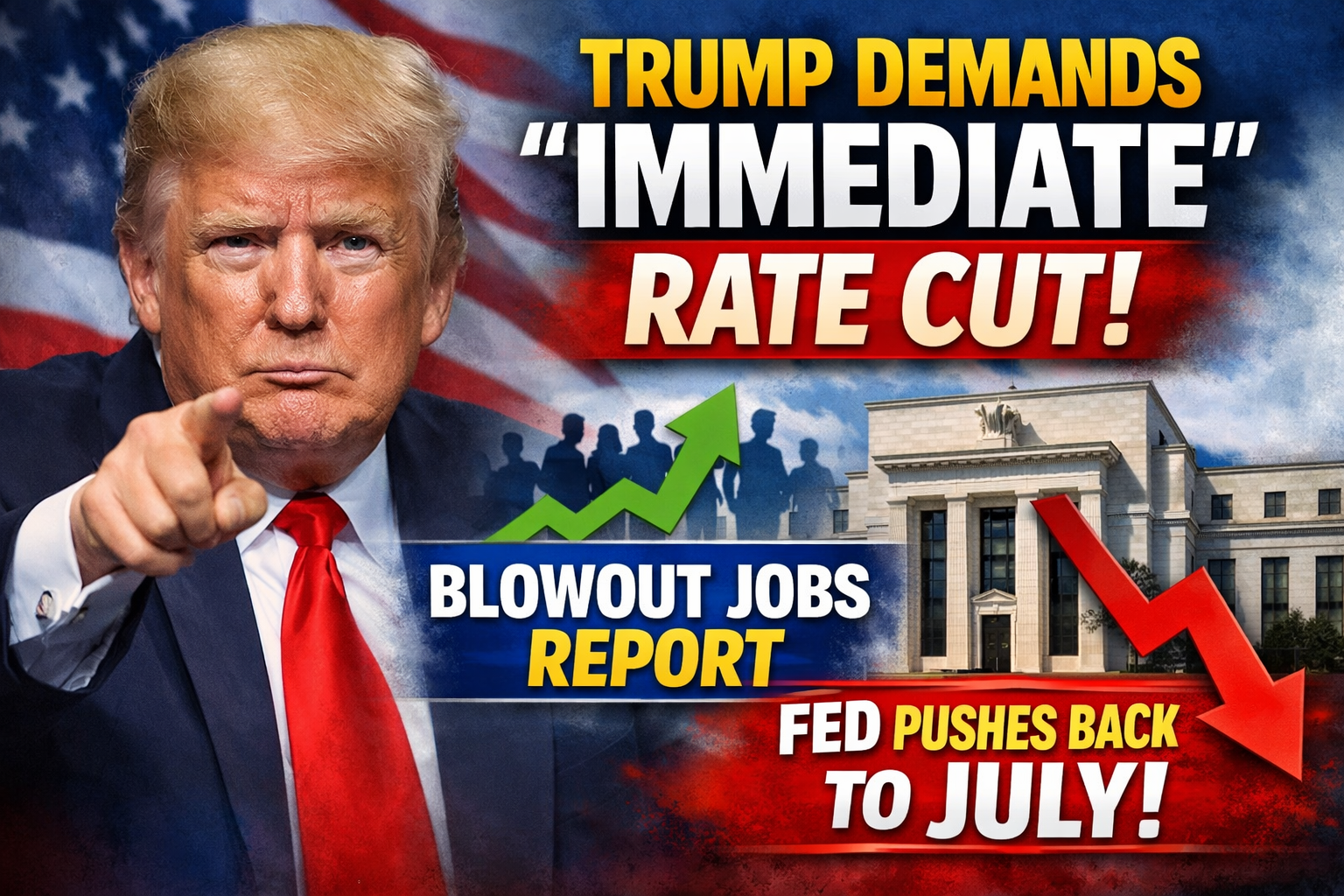
Trump Demands ‘Immediate’ Rate Cut After Blowout Jobs Report – Fed Pushes Back to July
Trump Demands WASHINGTON – A political and economic firestorm erupted on Wednesday after President Donald Trump used the release of a stunningly strong January jobs report to demand an immediate and drastic reduction in interest rates. However, Wall Street and the Federal Reserve are sending a clear message back to the White House: Not so fast.
The United States Department of Labor announced new job figures that showed an increase in the number of jobs in the American economy during the month of January. The American economy created 130000 jobs as compared to the expected 55000 jobs that the economy was forecasted to add by economists. The unemployment rate went down to 4.3% as it attained its lowest level since August 2025.
While Trump hailed the numbers as proof that America deserves “the lowest interest rates in the world,” traders immediately pushed their bets for the next rate cut from June to July
[Video:- US Adds 130,000 Jobs in January, Unemployment Falls]
The ‘Blowout’ Report That Changed Everything
The January jobs report showed positive results, but it created an unexpected effect on the economy. The Reuters economists predicted a 70000 job increase for the economy, while some analysts estimated 10000 job losses. The labor market hit the accelerator.
“The market was set up for a much weaker number,” said Art Hogan, Chief Market Strategist at B. Riley Wealth. “This report today caught a lot of people by surprise. It is unambiguously good news”
[Read also:- Gas Prices Check: Will New Policy Lower Your Monthly Bill?]
Key highlights from the report:
- Nonfarm Payrolls: +130,000 (Actual) vs. +55,000 (Forecast)
- Unemployment Rate: 4.3% (Down from 4.4%)
- Manufacturing Jobs: Increased for first time since late 2024
- Labor Force Participation Rate: Increased
Ellen Zentner at Morgan Stanley Wealth Management noted, “Markets may have been expecting a downshift in today’s numbers after last week’s soft data, but the jobs market hit the gas pedal instead”
Trump’s Demand: ‘We Deserve Lowest Rates’
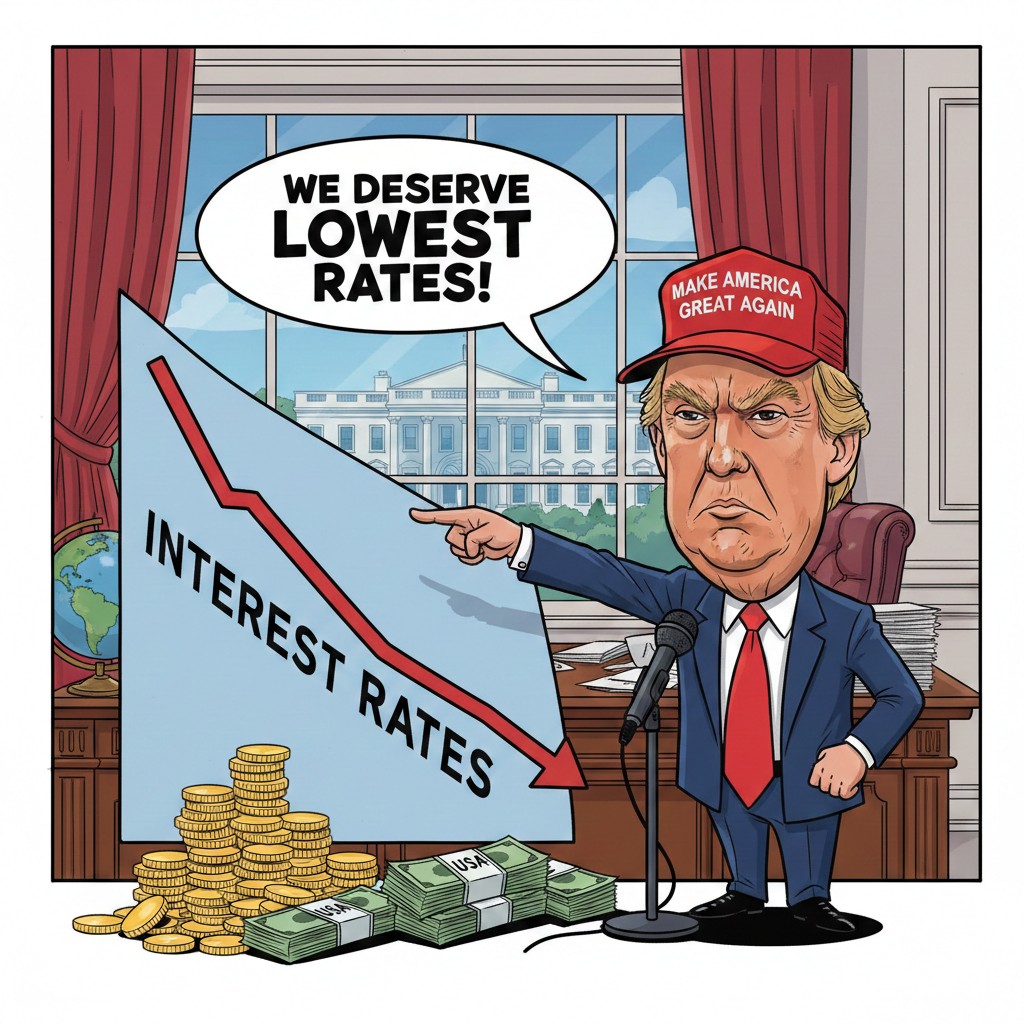
Minutes after the data dropped, Trump took to his Truth Social platform. He didn’t just praise the jobs numbers; he weaponized them.
“The United States should pay much lower costs for borrowing ( bonds !),” Trump wrote. “We are once again the strongest country in the world, so we deserve to pay the lowest interest rates, and much lower than other countries” .
Speaking to Fox News’ Larry Kudlow, Trump quantified his demand. He argued that if the Fed dropped rates by just two points, “we don’t have a deficit anymore,” claiming each percentage point drop saves $600 billion in debt service .
Trump has repeatedly urged the Fed to lower rates to 1% . With inflation hovering around 2%, this would effectively create a negative real interest rate
The Fed’s Cold Response: July or Later
Despite the President’s pressure, the math on Wall Street moved in the opposite direction.
Before the report: Markets were pricing in a June rate cut.
After the report: Markets fully priced in July as the next move .
“This report pours cold water on the idea the Fed could cut rates again before mid-year,” said Krishna Guha at Evercore .
Treasury yields spiked immediately. The 2-year yield, which is highly sensitive to Fed policy, climbed six basis points to 3.51% . The 10-year yield rose to 4.17% .
Here is the market shift visualized:
Table 1: Market Repricing of Fed Rate Cut Bets
| Fed Meeting | Probability Before Jobs Report | Probability After Jobs Report | Outcome |
|---|---|---|---|
| March 2026 | ~15% | <5% | Effectively Dead |
| June 2026 | 70% (Priced In) | 30% | Delayed |
| July 2026 | 40% | 100% (Priced In) | New Base Case |
The Warsh Factor: Will Trump’s Own Pick Delay Cuts?
Here is the irony that markets are currently wrestling with: Trump’s own nominee for Fed Chair might not give him the cuts he wants.
Trump announced last month he would nominate Kevin Warsh to replace Jerome Powell when Powell’s term ends in May . Initially, markets expected Warsh to be a sure bet for lower rates.
However, analysts now warn that a strong labor market could tie Warsh’s hands.
“If the u-rate is stable or down even further by June, Warsh might be stuck on hold for the rest of the year,” warned strategists at Bank of America .
Seema Shah, Chief Global Strategist at Principal Asset Management, put it bluntly: “It will not be an easy task for Kevin Warsh to persuade the FOMC to ease policy at his first meeting. Absent a clearer and sustained deceleration in inflation, the labor market will not make that case for him” .
Who is Kevin Warsh?
At a Glance)| Attribute | Details |
|---|---|
| Nomination Status | Announced by Trump (Jan 2026) |
| Current Fed Chair | Jerome Powell (Term ends May 2026) |
| Market Expectation | Previously Hawkish, but uncertainty rising |
| BoA Forecast | 2 cuts in 2026 (if labor cools) |
Why Good News Became ‘Bad News’ for Borrowers
“Good news for the economy can be bad news if you’re expecting rate cuts,” Hogan explained. “I certainly think this will be seen long-term as a good news story” .
Mike Reid at RBC Capital Markets solidified the new outlook: “Don’t let the revisions fool you. The January employment report showed continued improvement in the US labor market. Looking ahead, this print solidifies our view that the Fed will go on a long pause in 2026”
Conclusion: A Standoff Set for Summer
The February 11 jobs report did not just reset economic forecasts—it reset the political battlefield.
President Trump now heads into the spring demanding rate cuts with a stronger economy as his justification. However, that same economic strength gives the Federal Reserve (whether led by Powell or Warsh) the perfect cover to wait.
Unless Friday’s CPI inflation report shows a dramatic collapse in prices, the next Fed rate cut is now officially a July story.
Read also:- Grammy 2026: Bad Bunny Makes History & Kendrick Sweeps!
FAQs
Q1. Why did Trump demand lower rates if the economy is doing well?
Q2. If the jobs report was so good, why did the market push rates to July?
A. The Fed cuts rates to stimulate a weak economy or fight a recession. A strong jobs report signals the economy does not need immediate help, allowing the Fed to wait and monitor inflation
Q3. What is Kevin Warsh’s stance on interest rates?
A. Historically, Warsh is considered more hawkish than Powell. However, Bank of America notes that if the economy slows, Warsh could actually deliver more cuts than Powell would have
Q4. When is the next Fed meeting?
A. The next FOMC meeting is in March 2026. Markets currently see a less than 5% chance of a rate cut at that meeting
Q5. Could the Fed still cut rates in June?
A. It is unlikely. Traders have moved their primary bet to July. However, if Friday’s CPI report shows inflation significantly lower than expected, June could come back into play