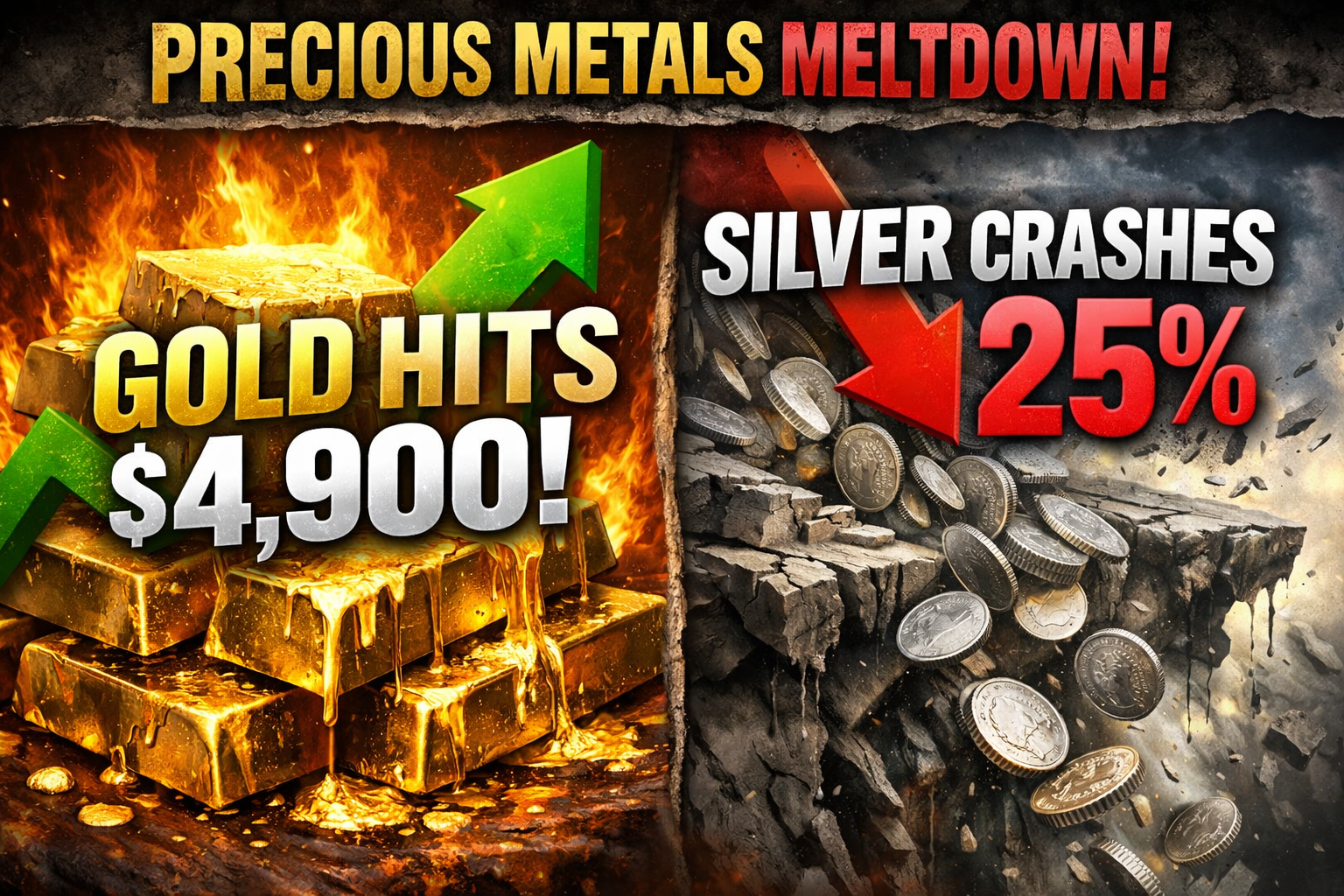
Precious Metals Meltdown: Gold Hits $4,900 & Silver Crashes 25%
Precious Metals Meltdown: Gold Hits $4,900 & Silver Crashes 25%. The financial world was left in shock this week as the seemingly unstoppable rally in precious metals came to a grinding halt. After reaching historic highs, both Gold and Silver experienced a massive sell-off, triggered by a combination of political appointments, margin calls, and a classic “unwinding” of over-leveraged positions.
In this detailed report, we break down why Gold fell below the psychological $5,000 mark and why Silver suffered one of its worst single-day crashes in history.
The Catalyst: The “Warsh” Effect
The primary trigger for the market meltdown was the news of Kevin Warsh being nominated as the next Chair of the U.S. Federal Reserve. Known for his “hawkish” stance and focus on financial stability, his nomination sent ripples through the commodities market.
[ NVIDIA Q4 Financial Results: Mark Your Calendars for the Big Reveal! ]
Traders who had bet on gold as a hedge against inflation and a weak dollar suddenly scrambled to exit their positions, fearing a stronger dollar and higher interest rates under Warsh’s potential leadership.
The Silver Crash: A 25% Meltdown
While gold’s decline was significant, silver stole the headlines for the wrong reasons. Silver, which had been the “speculative darling” of 2025, crashed by 25%. This was fueled by:
- Margin Requirements: Exchanges increased the cost of trading, forcing leveraged traders to sell.
- FOMO Reversal: Retail investors who bought at the peak were caught in a “cascading effect,” selling rapidly as prices dipped.
- Industrial Concerns: With trade tensions and tariffs making headlines, the industrial demand for silver came under scrutiny.
Key Market Statistics: Gold vs. Silver
[ 2026 Grammy Predictions: Will Kendrick Lamar & Lady Gaga Sweep the Night? ]
Below is a comparison of the price action during this historic trading session.
| Metric | Gold (XAU) | Silver (XAG) |
|---|---|---|
| Peak Price (Jan 2026) | $5,418 /oz | $84.00 /oz |
| Current Price (After Crash) | $4,900 /oz | ~$63.00 /oz |
| Percentage Decline | ~9.5% from Peak | 25% |
| Volatility Level | Moderate (20%) | Extreme (36%+) |
| Market Sentiment | Correctionary | Panic Selling |
Technical Breakdown: Why the Trade Unwound
For months, technical indicators like the Relative Strength Index (RSI) had been flashing “Overbought” signals (above 70). This indicated that the rally had run too fast. When the Warsh news hit, it acted as the needle that popped the bubble.
Price Movement Timeline
This table illustrates the rapid descent over the final week of January 2026.
| Day of Week | Market Event | Gold Impact | Silver Impact |
|---|---|---|---|
| Wednesday | All-time Highs reached | +$120 | +$5.00 |
| Thursday | Profit booking begins | -$40 | -$2.50 |
| Friday AM | Kevin Warsh Fed Nomination | -$250 | -$12.00 |
| Friday PM | Margin Call Cascades | Hits $4,900 | Total -25% Drop |
Visualizing the Crash: Price Action Chart
Visual Price Projection (Silver & Gold)
  Price ($)
    ^
    |      * (Peak: Jan 28)
    |     / \
    |    /   \
    |   /     \  <-- Thursday: Initial Selling
    |  /       \
    | /         \____  <-- Friday: THE CRASH
    |/               \
    |_________________\_________________> Time
Note: The sharp vertical drop on Friday represents the liquidation of over $10 Billion in paper metal contracts.
Investor Takeaway: Is the Gold Bull Market Over?
Financial advisors suggest that while this “unwind” is painful, it is a healthy correction for a market that was overextended. Most experts still recommend a 5–15% allocation of precious metals in a diversified portfolio. However, the lesson of January 2026 is clear: Volatility cuts both ways.
Key Tips for Traders:
- Avoid FOMO: Don’t buy when the RSI is above 70.
- Monitor the Fed: Watch Kevin Warsh’s statements closely for future interest rate hints.
- Physical vs. Paper: Remember that paper futures (leverage) crash much harder than physical bullion.
FAQs:- Precious Metals Meltdown: Gold Hits $4,900 & Silver Crashes 25%
Q1. Why did Gold and Silver prices crash suddenly?
A. The crash was triggered by the nomination of Kevin Warsh as Fed Chair, signaling a stronger dollar and higher interest rates, which caused investors to exit “safe-haven” trades.
Q2. How far did Silver actually drop?
A. Silver experienced a massive 25% meltdown, falling from its recent highs near $84 down to approximately $63 per ounce in a single trading cycle.
Q3. Is Gold still a good investment after hitting $4,900?
A. Most analysts view this as a market correction rather than a dead end. While prices are lower, the long-term value of gold often remains stable after the “leveraged” traders leave the market.
Q4. What role did “Margin Calls” play in the crash?
A. As prices started to dip, exchanges raised trading costs. Investors who couldn’t afford the higher fees were forced to sell their positions immediately, causing the price to spiral downward faster.
Q5. Should I buy the dip or wait?
A. Market volatility remains high. Experts suggest dollar-cost averaging (buying small amounts over time) rather than dumping all your capital in at once while the market is still unstable.